

A good listing agent markets your home, a better one also negotiates hard for you, and the best ones bring a vision for what your home could sell for and what to change to get there. That last step happens before the listing goes live, and it's where we've seen the most value added.
When you interview agents, almost all of them will talk about photos, online exposure, and open houses. That's the baseline. Here's how we think about the three levels, and what to ask so you can tell which one you're talking to.
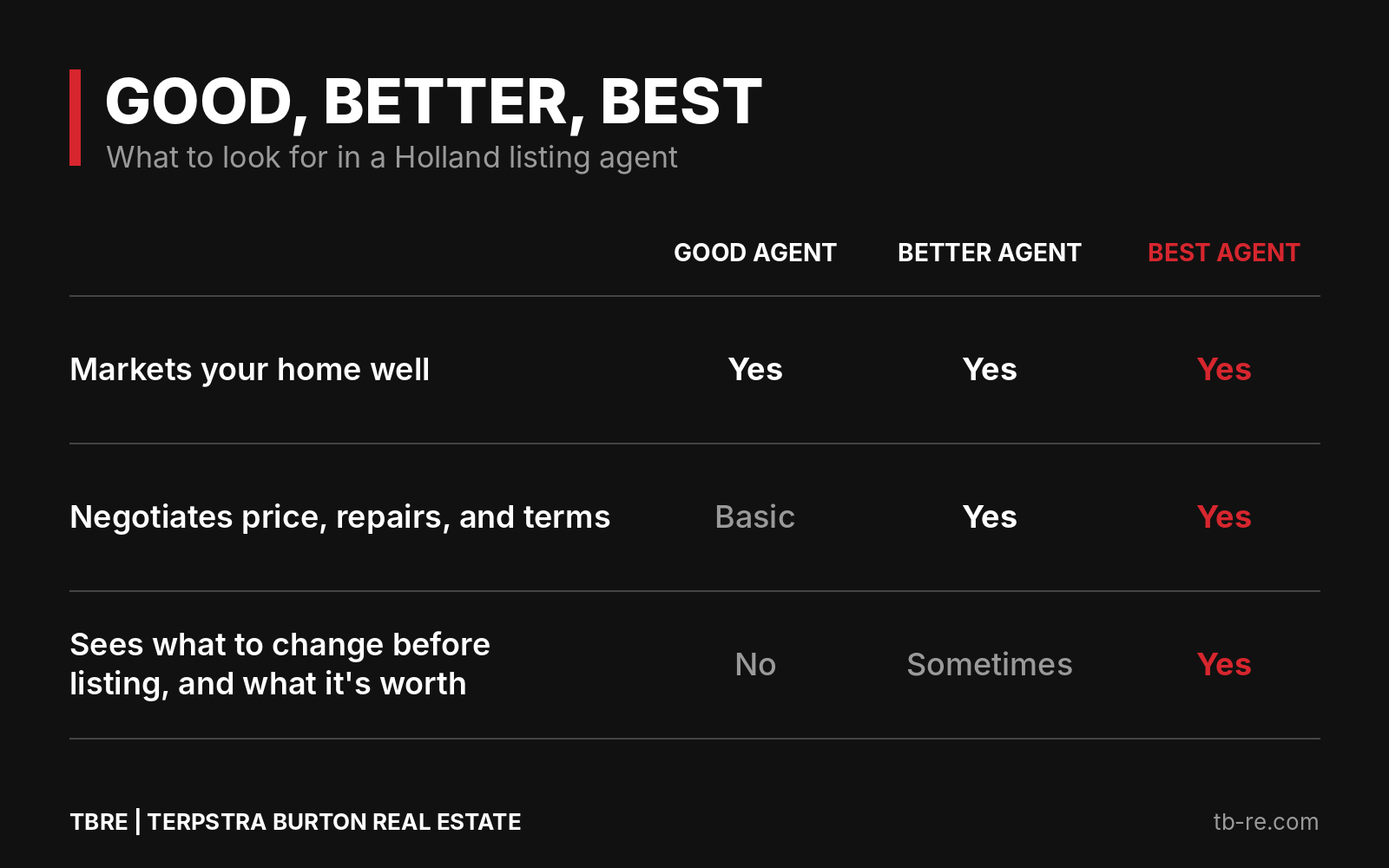
Good agent
Markets your home well: Yes
Negotiates price, repairs, and terms: Basic
Sees what to change before listing, and what it's worth: No
Better agent
Markets your home well: Yes
Negotiates price, repairs, and terms: Yes
Sees what to change before listing, and what it's worth: Sometimes
Best agent
Markets your home well: Yes
Negotiates price, repairs, and terms: Yes
Sees what to change before listing, and what it's worth: Yes
A good agent: gets your home seen
Good marketing makes sure the right buyers see your home and want to visit. It's the part of the job every seller expects, and it matters: many buyers decide whether to book a showing from the photos.
Good marketing includes:
Professional photos taken after the home is prepped, on a bright day.
A listing description that explains what makes the home worth its price, not just the bedroom count.
Wide exposure: the MLS, the major home search sites, social media, and the agent's own network.
Showings and open houses that are easy for buyers' agents to book.
If an agent can't show you strong examples of all four, keep looking. But marketing alone sells the house as it is, at whatever price the market gives it.
A better agent: protects your price at the table
Negotiation is where a sale's price holds or slips, and it doesn't end when you accept an offer. With more homes for sale in Ottawa County this fall than in the spring, buyers have room to push, so the agent across the table matters.
A better agent:
Compares offers on what you'll actually net, after credits, repairs, and closing costs, not just the headline price.
Reads the buyer's position: their financing, their timeline, and how many other homes they're considering.
Handles the inspection response with facts. Knowing what a repair really costs keeps a small fix from turning into a big credit.
Keeps the deal together through closing, when appraisal, lender, and timing issues come up.
This is where thinking like an inspector pays off. We usually know what a buyer's inspector will find before they do, so we can fix it ahead of time or price it in, rather than negotiate it under pressure.
The best agent: brings a vision for your home
The best agents walk your home and see what it could sell for, then show you exactly what to change to get there. Marketing and negotiation work with the house you have. A vision changes the house buyers see, before it ever hits the market.
On one recent home, we planned about $30,000 of updates, and it sold for $877,000 six months after it was bought for $740,000. That's $137,000 more. None of it was a remodel. It was a short list of the right changes, chosen for that house and its price range.
The kinds of updates we recommend most often:
A defined home office in a spare bedroom, den, or bonus space.
Built-in nooks: a window seat, breakfast nook, or mudroom bench.
Wall sconces and better lighting, which make rooms feel warmer and photograph well.
A coffee bar that makes the kitchen feel finished.
New countertops, the biggest visual change in a kitchen for a fraction of a remodel.
Paint, fixtures, and hardware that make the whole house read as cared for.
This takes looking at a house three ways: like a builder, to know what the house can take and what each change should cost; like an inspector, to fix what a buyer would flag; and like a designer and seller, to pick the updates buyers will pay more for. We grew up on job sites and in a lumber yard, so that's how we see every house. Our seller's guide has the full list of what to fix, refresh, and leave.

Questions to ask when you interview agents
The fastest way to tell good from best is to ask about your house, not about their marketing plan.
"If this were your house, what would you change before listing, and what would you leave alone?"
"What would each of those changes cost, and what do you expect it to add to the price?"
"What will a buyer's inspector flag here?"
"How would you price it, and which recent sales is that based on?"
"Walk me through how you'd respond to an inspection request."
A best-level agent will have specific answers on the first walkthrough.
Thinking about selling in Holland?
Are you looking to sell but worried your home isn't ready? Talk to us. We will build you a plan to get the most value for your home!
Liz Burton (616) 218-6402 lizburton@homelakeshore.com
Sean Terpstra (616) 886-9839 sean@homelakeshore.com
Sources: WMLAR, West Michigan Housing Market September 2026 (Ottawa County active listings, April vs. September 2026).